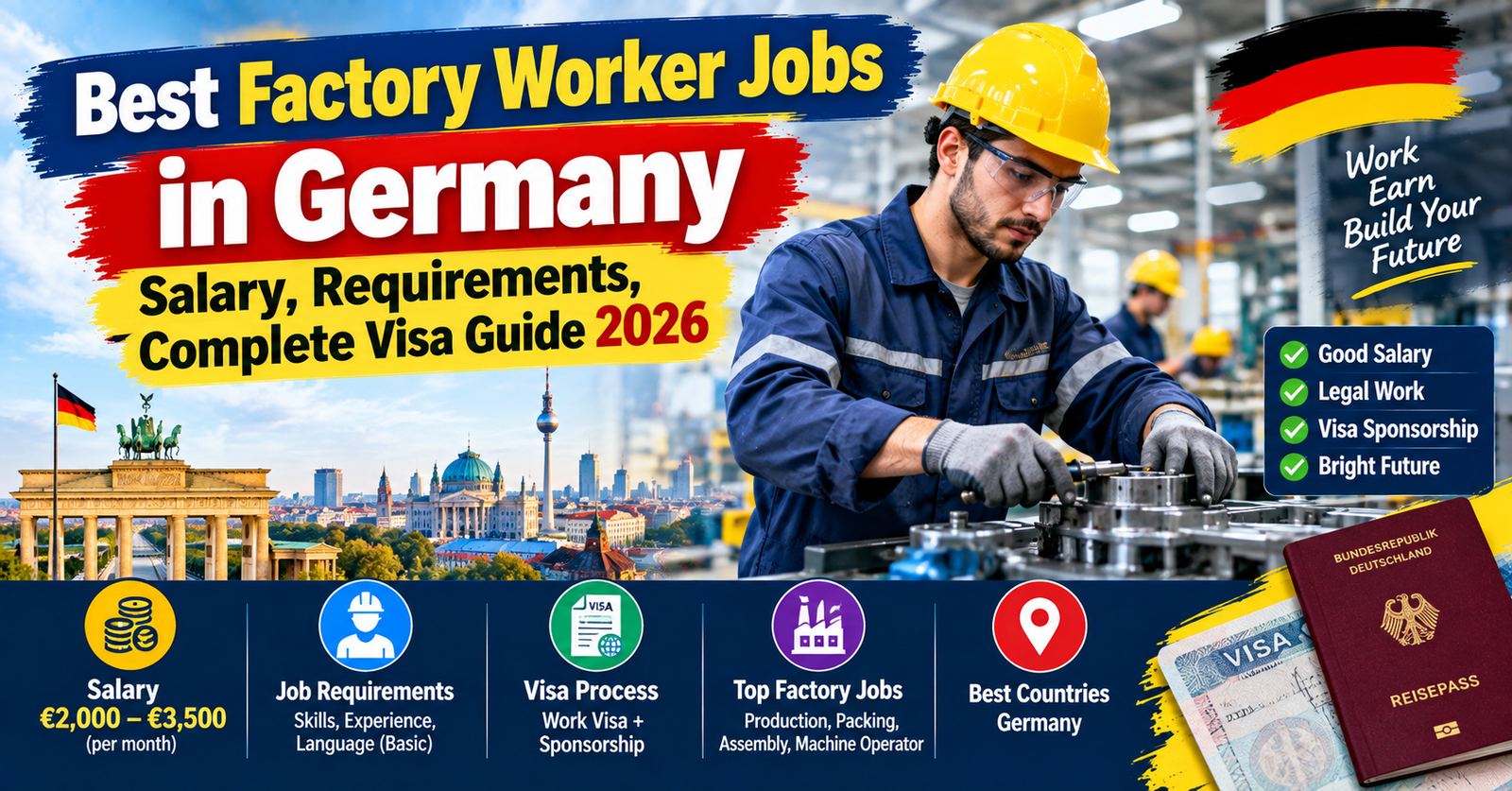
Best Factory Worker Jobs in Germany: Salary, Requirements,Complete Visa,Guide 2026
Germany is known for its highly developed manufacturing industry. It is in Germany that not only automoblies, engineering equipment, food, and pharmaceutical products are produced, but also electronics, industrial machinery. This is why factory jobs in Germany can be a great opportunity for those people who have the necessary skills and work experience.
Working in a factory in Germany means gaining new experiences and accumulating valuable skills. Nevertheless, it is important to understand what requirements are made, what work regime is provided, what salary is given, what language level is needed, and what visa regime is set.
We will discuss what factory jobs are in demand, what salary is provided, what qualifictions and skills are required, and how to search for factory vacancies.
Why Are Factory Workers Needed in Germany
Factory jobs are highly demanded in Germany. More precisely, the manufacturing industry in Germany is well-developed: from automotive to engineering, from food to electronics and pharma, from logistics to machinery. This industry is multifaceted and well-developed, which means that factory jobs in Germany can be of two types: from simple (no skills needed) to complex (high skills and work experience needed). In other words, the novice who does not have skills and experience will be able to gain new ones while working in a factory in Germany. Meanwhile, those who have skills and work experience will be able to apply their knowledge doing more challenging and highly paid factory jobs in Germany.
Types of Factory Worker Jobs in Germany
Factory jobs can differ significantly depending on the needs of a particular industry and the factory itself.
Production worker
They assist in the production and assembly of products. They perform the simplest types of assembly, prepare materials, operate simple machines, and inspect the produced items.
Machine Operator
Machine operators are responsible for the simplest maintenance and repair of machines, tools, and equipment and actually perform the production or manufacturing of a product. They also assemble machines, install and adjust them, and make the necessary settings.
If you have the necessary skills and work experience in the machine operating field, then this factory job in Germany will be a good choice for you.
Packing worker
They pack the company’s products. They also perform the simplest labeling, sorting, and packing of products, as well as storing them. They also take care of the territory and inventory.
Warehouse and factory worker
These workers perform the simplest tasks both in the factory and in the warehouse, most often related to preparing goods for shipment. They also drive cars and operate machines.
Quality control worker
They test and inspect products to ensure that they meet the established standards. Factory jobs in quality control are ideal for people who like details and are scrupulous.
Assembly worker
They assemble products according to drawings or other documents. Assembly workers are in demand in Germany in the automotive and electronics industries, as well as in the machinery industry.
Food production worker
They deal with the production of food and interact with various machines. Moreover, factory jobs in the food industry have their own specific health and safety standards that must be met, which may differ from employer to employer.
Factory Worker Salary in Germany
Factory worker salary in Germany varies significantly depending on the region, employer, industry, shift, years of experience, education, and many other factors. A simple position or an entry-level factory job, for example, starts from €2,300 to €3,200 per month (gross). A more specialized and qualified factory job, for example, a machine operator, will have a significantly higher average monthly salary.
The critical detail is that these are gross salaries, which means that the net income after taxes will be significantly lower.
Accordingly, when comparing salaries and searching for factory jobs in Germany, it is important to consider the entire package of benefits.
Factory Worker Requirements: What Do I Need to Know?
The necessary skills and work experience strongly depend on the position itself, the industry, and even the factory. Some employers are looking for your technical skills, while other employers are more interested in your ability to do simple repetitive actions and adhere to the rules of discipline.
In other words, for entry-level factory jobs, such as production worker, the main requirements may include willingness to work in shifts, physical fitness according to the duties of the position, and the ability to follow instructions. At the same time, for specialized jobs, the situation is completely different: they require technical skills and work experience. A list of required and desirable skills for factory jobs in Germany can include:
- Experience in the factory
- Performing simple repetitive movements
- Working with machines
- Technical expertise
- Forklift driver’s certificate
- Quality inspector
- Computer skills
- Safety knowledge
- Mechanical knowledge
If you have the necessary skills and certificates, then be sure to have them at hand and update your skills from time to time.
Is German Required for Factory Jobs?
The ability to speak German is not required but will significantly increase your chances of being hired. It is vital to understand that language barriers are one of the main problems in the search for employment. Even though some international companies are looking for employees who speak English, the vast majority of local companies will communicate in German, including technical specifications and safety instructions.
Accordingly, to increase your chances of finding a job in a factory in Germany, you need to devote time and effort to learning the local language.
What’s more, it is essential to understand that language skills are important not only for white-collar jobs but also for blue-collar jobs. While entry-level factory jobs may not require advanced German skills, technical jobs will require more profound language knowledge.
Factory Worker Hours: What Do I Need to Know?
Factory jobs typically require a shift work regime. This means that shifts in factories can be morning, evening, or night shifts. In addition, there are also weekend shifts, which are usually more paid than regular shifts.
It goes without saying that the number of hours you are willing to work and the shifts you are willing to work in must be specified in your contract. Equally important, your working hours, shifts, overtime, holidays, and days off should be indicated separately.
Factory Jobs in Germany for Foreigners
Germany is in dire need of foreign specialists: they are welcomed and in demand. However, it is vital to understand that a job in a factory for foreigners is not always a visa opportunity.
Depending on your citizenship, industry, position, and even personal qualities, your chances of finding a job in factory in Germany will vary.
In other words, blue-collar factory jobs do not require the same amount of documentation as white-collar jobs.
If you are not a citizen of the EU, be sure to study Germany’s visa and migration laws to find out if you suit the requirements.
Germany Work Visa for Factory Workers
Factory jobs for foreigners in Germany can be both with and without a visa. The second option is available to citizens of developing countries. The list of these countries is available on the website of the German Federal Employment Agency.
In addition, there are several types of visas for foreigners who want to find a job in Germany. The type of visa depends on your citizenship, education, work experience, language skills, job offer, and many other factors.
Work permits are issued for specific positions and organizations. This means that to find out if you meet the visa and migration requirements, you need to contact your local German embassy.
In any case, the documents that you will need to provide include:
- A valid passport
- Contracts with a potential employer
- Certificates, diplomas, and other documents confirming your education
- The resume
- Documents confirming the place of residence (if any)
- Insurance policy (if any)
- Documents confirming work experience (if any)
- Any other documents related to your visa and migration issues
It is always essential to double-check the information provided by your embassy. Besides, it is a good idea to collect as much information as possible from official government resources rather than job portals and social networks.
How to Find Factory Jobs in Germany
There are several ways to find a job in factory in Germany. In particular, you can use online job portals, study the websites of manufacturers that interest you, and contact local recruitment agencies. However, it is vital to realize that searching for jobs in English will significantly reduce your opportunities. The reason for this is that many job vacancies are hidden from search engines and are only available to users who know how to extract information from special databases. Accordingly, to find the most suitable factory job in Germany, it is necessary to know how to deal with the local language.
In addition, it is vital to search for factory job vacancies in German rather than English. To do this, you need to know the German equivalents of the positions that interest you. Here are some of the most common terms:
- Produktionsmitarbeiter
- Produktionshelfer
- Maschinenbediener
- Produktionsmitarbeiter Quereinsteiger
- Mitarbeiter Produktion
- Montagearbeiter
- Fabrikarbeiter
How to Apply for Factory Jobs in Germany
Your resume is the key document in the search for a job. It is vital to modify it and highlight those parts that show your skills and abilities as a future factory worker.
Below is a list of information that should be included in your resume when applying for a factory job in Germany:
- Personal information
- A short personal profile
- Work experience
- Any experience in the factory or manufacturing sector
- Technical expertise
- Education
- Language skills
- Any certificates and references
- Forklift or driving license (if available)
In addition, be sure to indicate your work experience in as much detail as possible if it is relevant to the factory or production profile in which you are looking for a job.
Another tip to speed up the hiring process is to write a short letter of recommendation.
Skills Employers Look For in Factory Workers
Committed and reliable workers who are clean, punctual, and observe the rules of discipline are in demand throughout the German factory industry.
In addition, the most in-demand skills for factory jobs in Germany include:
- Teamwork
- Attention to detail
- Time management
- Physical stamina
- Safety awareness
- Basic technical knowledge
- Machine operation
- Problem solving
- Responsibility
- Shift work
Factory Jobs for People Without Experience
Factory jobs do not necessarily require previous work experience, but to obtain such a job, you need to know how to work with a machince and be physically strong enough to handle the production line.
Having said that, there are entry-level jobs that do not even require basic skills and physical abilities. Such vacancies are looking for responsible and attentive workers who will do the job assigned to them with minimal errors.
Cost of Living in Germany
Factory worker salary in Germany is enough to cover the cost of living. However, this will vary depending on where in Germany you will find a job and what accommodation options will be available to you.
It is vital to understand that the cost of real estate varies significantly from city to city. While some cities have a wide variety of affordable housing, other cities are much more expensive.
In addition to housing, you will have to budget for food, travel, health, and mobile phone and internet services.
By default, an entry-level factory worker will need at least €2,500 per month for food, clothing, transportation, and accommodation. If you decide to settle in one of the big cities, such as Berlin, Munich, or Frankfurt am Main, then you will have to revise your budget.
Finally, it is essential to count how much money you will receive per month without deducting taxes and other payments. This is not a problem since the gross and net income are indicated for each position.
Most employers provide factory housing, but it is vital to know if it is allocated at the expense of the factory or the worker.
Fake Factory Jobs: How to Avoid Getting Scammed
When searching for factory jobs in Germany, you need to be wary of scammers. Among the signs of a fake job, the following can be noted:
- Offer of large salaries
- Asking for advances to join the program
- A large number of fake job offers
- Presence of scams in reviews
- Website with low quality, amateurish structure, and content
- Presence of suspicious intermediaries, including unofficial recruiters
- Requirement to pay a deposit or fee to get a contract
Final thoughts
Factory jobs in Germany can be a great opportunity to gain experience and start a successful career in the industry.
Factory jobs in Germany are in demand in almost all industries and sectors. Entry level factory jobs require only a small amount of skills and work experience, while specialized jobs offer great salaries. Finding a job in factory for foreigners is no different from searching for a job in the local market, but there are additional challenges related to the visa regime and language barriers.
Nevertheless, the ability to prepare all the necessary documents and improve your language skills will help you find a factory or manufacturing job in Germany quickly and easily.
A few final words of advice: be sure that the company for which you are looking for a job exists and that the job offer is real.